
| Getting your Trinity Audio player ready... |
You know that feeling when you open your closet and immediately feel overwhelmed?
Not because it’s packed to the brim. Not because clothes are falling off hangers or piled on the floor.
Just… overwhelmed. Like you can’t see what you have. Like you have a closet full of clothes but nothing to wear.
I see this all the time in the Houston homes I organize. And here’s what I’ve learned after over a decade of doing this work:
The problem isn’t that you have too many clothes.
The problem is that your everyday t-shirts, your winter coats, your bridesmaid dresses from 2015, and your “maybe someday” jeans are all competing for the same space.
And that creates chaos—even when there’s technically room.
The Three Categories Your Closet Is Trying to Hold
When I walk into a closet that feels chaotic, I can usually see the problem immediately.
There are three completely different types of clothing trying to share the same few feet of hanging space:
Category 1: Your Active Wardrobe
These are the clothes you actually wear. The t-shirts you reach for every week. The jeans that fit. The work pants that are comfortable. The dress you wore last Tuesday.
This is your real wardrobe. The stuff that makes up your actual life.
In a well-organized closet, your active wardrobe should take up about 60-70% of your prime hanging space—the section you can reach without stretching or bending.
Category 2: Seasonal and Archive
These are clothes you definitely wear, just not right now. Winter coats in July. Swimsuits in January. That formal dress you wear to weddings twice a year.
You need these items. But they don’t need to be in your prime closet real estate when you’re not using them.
Category 3: Aspirational and Someday
These are the clothes you’re keeping “just in case.” The jeans from three sizes ago. The blazer you’ll wear when you get that job. The dress you bought on sale and never wore.
These items aren’t serving you right now. And they’re taking up space that your actual wardrobe needs.
What Happens When Everything Competes
Here’s what I see in most closets:
All three categories are mixed together. Your favorite jeans are hanging next to a bridesmaid dress from 2012. Your go-to work shirts are crammed between a winter coat and a formal gown you wear once every two years.
Every time you get dressed, you’re visually scanning through items you’re never going to wear today. Your brain has to process and dismiss dozens of pieces before finding what you actually need.
That’s exhausting.
And it makes getting dressed take longer, feel harder, and leave you feeling like you have nothing to wear—even when your closet is full.
The Active Wardrobe Concept
Here’s how I organize closets for my clients, and it changes everything:
We identify the active wardrobe first.
Your active wardrobe is what you wear in a typical two-week cycle. Not what you might wear someday. Not what you wore five years ago. What you’re actually wearing right now, in your current life.
For most people, that’s:
- 7-10 tops you rotate through
- 3-5 pairs of pants or jeans
- 2-3 jackets or cardigans
- A few dresses or outfits for specific needs
That’s it.
Everything else? That’s either seasonal, special occasion, or aspirational.
Once we identify the active wardrobe, we give it the best real estate in the closet. The section at eye level. The part you can reach easily. The space where you can see everything at once.
That active wardrobe gets 60-70% of your prime hanging space.
Where Everything Else Goes
Now, I know what you’re thinking: “But what about all my other clothes?”
They don’t disappear. They just get relocated based on how often you actually use them.
Seasonal items go in higher or lower sections of the closet, or in storage bins if space is tight. You’ll pull them out when the season changes, but they don’t need to be in your face every single day.
Special occasion items—formal dresses, suits you wear twice a year, wedding guest outfits—get grouped together in a designated section. Usually at one end of the closet or on a higher rod.
Aspirational items get a reality check. If you’re keeping jeans from three sizes ago “for motivation,” they’re not motivating you. They’re making you feel bad every time you see them. It’s time to let them go.
How This Actually Works in Different Closet Types
The active wardrobe concept works in any closet. You just adapt it to your specific space.
Walk-In Closets
If you have a walk-in, this is straightforward.
Your active wardrobe gets the most accessible section—usually the main wall you see when you walk in. Everything at eye level, easy to reach, well-lit.
Seasonal items go on higher rods or in less accessible corners.
Special occasion pieces get their own designated section, usually grouped by type (all formal wear together, all winter coats together).
Reach-In Closets
In a standard reach-in closet, you’re working with limited space. So we get strategic.
Active wardrobe takes the center section—the part directly in your sightline when you open the doors.
Seasonal items go on the higher rod if you have one, or we use the far left and right sides of the main rod.
Special occasion pieces often need to move out of the closet entirely—maybe to a coat closet, a garment bag in another room, or under-bed storage.
Small Bedroom Closets
If you’re working with a tiny closet, we have to be even more intentional.
Only your active wardrobe lives in the closet. That’s it.
Everything else gets stored elsewhere:
- Seasonal items in bins under the bed or in a hall closet
- Special occasion pieces in garment bags
- Out-of-season shoes in boxes on a closet shelf or under furniture
Yes, this means you’ll do a seasonal swap twice a year. But it also means you can actually see and access the clothes you wear every single day.
The Two-Week Test
Want to know what should actually be in your active wardrobe?
Try this: For the next two weeks, pay attention to what you actually wear.
Not what you think you should wear. Not what you wish you wore. What you actually put on your body.
At the end of two weeks, those items? That’s your active wardrobe.
Everything you didn’t touch in those two weeks is either seasonal, special occasion, or something you’re keeping for reasons that might not be serving you anymore.
What This Usually Reveals
When clients do this exercise, they’re usually surprised by a few things:
They wear way fewer items than they thought. Most people rotate through about 20-30% of their wardrobe regularly. The rest just takes up space.
They’re avoiding certain items for specific reasons. That shirt that needs ironing. Those pants that are slightly uncomfortable. The dress that requires specific undergarments. These aren’t really part of your active wardrobe if you’re constantly working around them.
They have multiples of the same thing. Five black t-shirts, but you only ever wear two of them. Three pairs of jeans, but one pair fits better so that’s what you reach for. You don’t need the extras.
Creating Zones Within Your Closet
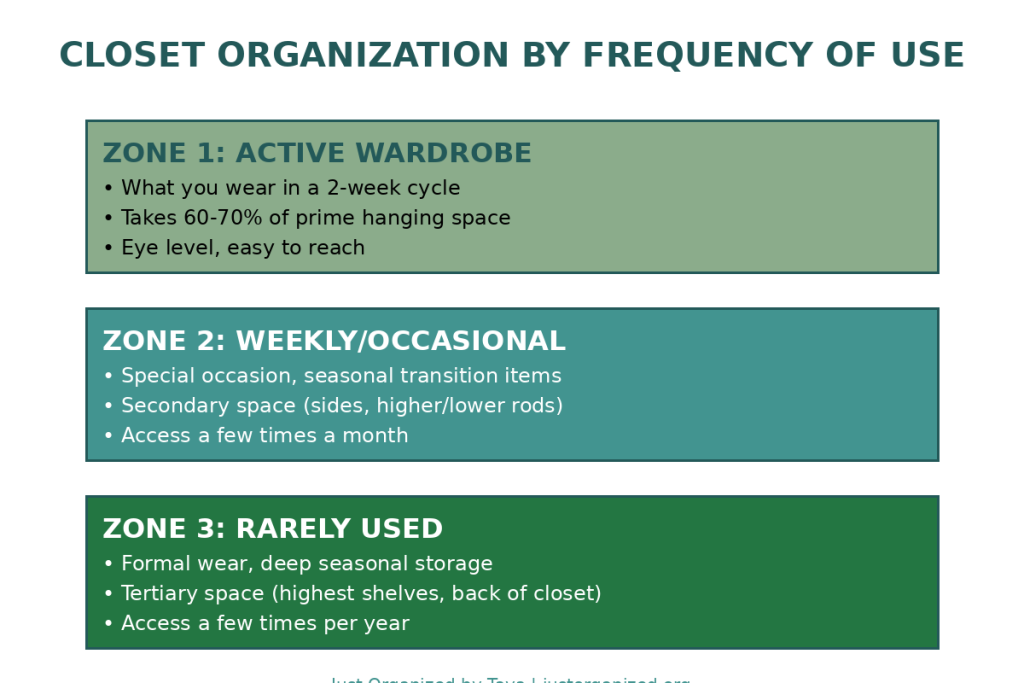
Once you know what your active wardrobe actually is, we create clear zones.
In professional organizing, we call this “zoning by frequency of use.” It’s one of the most effective strategies for making a space functional.
Here’s how it breaks down:
Zone 1: Daily Use (Your Active Wardrobe)
This gets prime real estate—the center section of your closet, at eye level, easy to reach.
Within this zone, organize by type: all shirts together, all pants together, all dresses together. Some people like to organize by color within each type. Do what makes sense for your brain.
The key is that you can see everything at once without moving anything.
Zone 2: Weekly/Occasional Use (Special Occasion, Seasonal Transition)
This goes in secondary space—the sides of your closet, higher or lower rods, less immediately visible sections.
You’ll access these items, just not every day. So they don’t need to be front and center.
Zone 3: Rarely Used (Formal Wear, Deep Seasonal Storage)
This goes in tertiary space—the highest shelves, the back of the closet, or outside the closet entirely in proper storage.
You might only touch these items a few times a year. They need to be stored properly and accessibly, but they don’t need to be taking up your everyday space.
What About Dresser Drawers?
The same concept applies to your dresser.
The drawers you can reach easily—usually the top two or three—should hold your active wardrobe items. The t-shirts you actually wear. The workout clothes you use this season. The pajamas you rotate through.
Lower drawers can hold seasonal items, out-of-season workout gear, or backup items you don’t need regular access to.
And if you’re keeping clothes in your dresser that you haven’t worn in six months? They’re either seasonal (in which case they should be labeled and stored properly) or they’re taking up space you need for items you actually use.
The “But What If I Need It Someday” Problem
I hear this constantly: “But what if I need it?”
Here’s what I tell clients:
If it’s genuinely useful and you will actually wear it—like a winter coat or a formal dress—then it’s not “someday.” It’s seasonal or special occasion. Give it proper storage in Zone 2 or 3.
But if it’s “someday when I lose weight” or “someday when I change careers” or “someday when my life is different”? That item isn’t serving you now. And it’s taking up space your current life needs.
You’re not organizing for someday. You’re organizing for today.
Why This Makes Getting Dressed Easier
When your closet is organized by frequency of use instead of just “all my clothes in one place,” getting dressed becomes so much faster.
You open your closet and see only the clothes you actually wear. You’re not scanning past formal gowns to find a t-shirt. You’re not digging behind winter coats to reach your favorite jeans.
Your brain doesn’t have to process and dismiss dozens of irrelevant options before finding what you need.
The cognitive load drops significantly. And suddenly, getting dressed in the morning stops feeling like a chore.
The Seasonal Swap
One question I get a lot: “Do I really have to do a seasonal swap?”
It depends on your space.
If you have a large walk-in closet, you might have room to keep everything accessible year-round. You’d still organize by frequency of use, but you wouldn’t need to physically remove items.
But if you’re working with a standard reach-in closet or a small bedroom closet? Yes, a seasonal swap makes a huge difference.
Twice a year—usually in spring and fall—you swap out seasonal items.
Put away heavy winter clothes. Bring out summer items.
Put away shorts and tank tops. Bring out sweaters and coats.
This takes about an hour twice a year. And it means your daily-use closet space actually serves your current needs instead of trying to hold clothes for every possible weather condition at once.
If You’re Doing the January Challenge
Days 9 and 10 of the January Decluttering Challenge focus on organizing t-shirts and going through jeans.
As you tackle those areas, ask yourself: Is this part of my active wardrobe, or is this something I’m keeping for other reasons?
If you haven’t worn it in the last month (and it’s not seasonal), it’s probably not serving your current life.
And that’s okay. You’re allowed to let go of clothes that don’t fit your life anymore.
Download the free challenge calendar if you haven’t already, and let’s tackle this together.
If Your Whole Closet Needs Help

If you’re reading this and realizing your closet needs more than just sorting through t-shirts—it needs a complete reorganization by frequency of use—I can help with that.
At Just Organized by Taya, I work with Houston-area families to create closet systems that actually work for daily life. We identify your active wardrobe, create proper zones, and set up storage that makes getting dressed easy instead of exhausting.
This isn’t about having an Instagram-perfect closet. It’s about having a closet that functions for your real life.
Book a consultation or call 832-271-7608. Let’s make your closet work for you.
(Not in Houston? I do virtual consultations too.)
Start With One Question
You don’t have to reorganize your entire closet today.
Just start by asking yourself one question:
What do I actually wear in a two-week cycle?
That’s your active wardrobe. Everything else is either seasonal, special occasion, or something you’re keeping for reasons that might not be serving you anymore.
Once you know what your active wardrobe actually is, you can start giving it the space it deserves.
And everything else can find a home that makes sense for how often you actually use it.
That’s when your closet stops feeling chaotic—and starts working for you.

Working with Taya and her team is easy. You can book an appointment easily on her website, or contact her directly at 832-271-7608
- The Real Reason Your Closet Feels Chaotic (Even When It’s Not Full) - January 15, 2026
- Why Getting Rid of Old Socks Feels Harder Than It Should - January 13, 2026
- Why You Keep Buying Duplicate Kitchen Items (And How to Actually Fix It) - January 8, 2026